
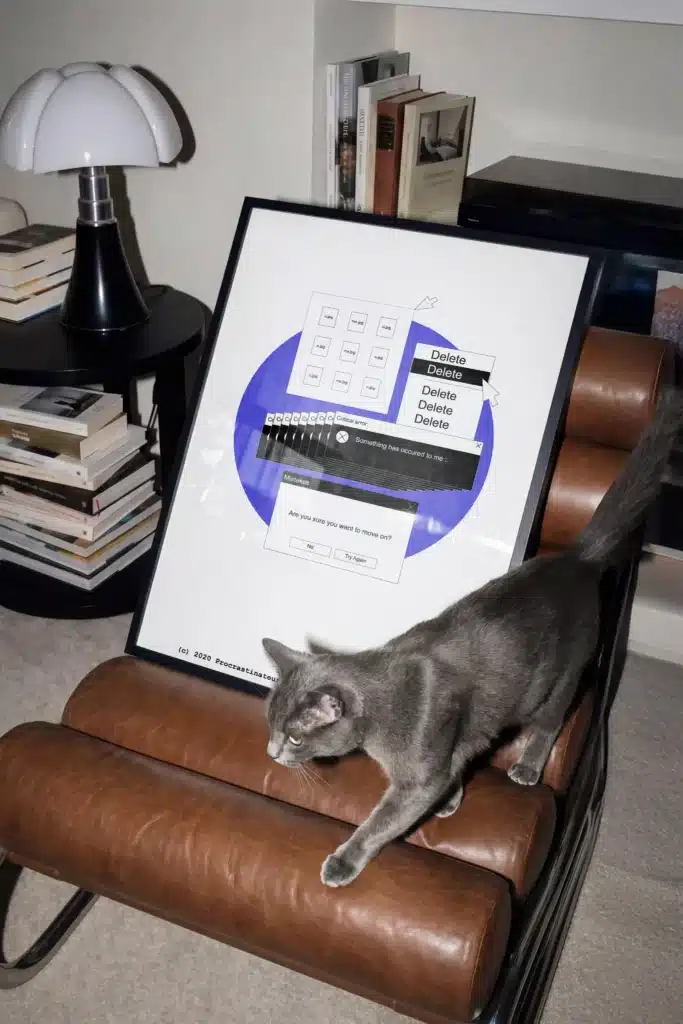
Not everything needs to be framed and hung to exist properly in a room.
There’s something a little rigid about the idea that a print has one correct destination — a nail, a wall, a fixed spot. In practice, the most interesting interiors tend to treat prints more loosely than that. Leaning against a shelf. Slipped between books. Propped on a mantelpiece and moved when something else takes its place.
Living with prints rather than just displaying them changes the relationship. A print you can pick up, rearrange, or swap out stays present in a different way than one that’s been in the same spot for three years. You notice it again. It earns its place repeatedly rather than once.
Shelves are particularly good for this. A print tucked between a stack of books and a lamp doesn’t need to be the focal point of the room. It can just be there, part of the texture of a space that’s lived in. The mix of objects around it — the spines, the small things, the lamp casting light across it — becomes part of how it looks.
It also makes collecting easier. When prints don’t require a permanent commitment, you can bring more of them in. Rotate them with the seasons, with your mood, with whatever you’re drawn to at a given moment. The ones that stay are the ones that keep earning it.
Some prints do belong on a wall. But not all of them, and not always.
— Studio Ninette, designed in Belgium.