
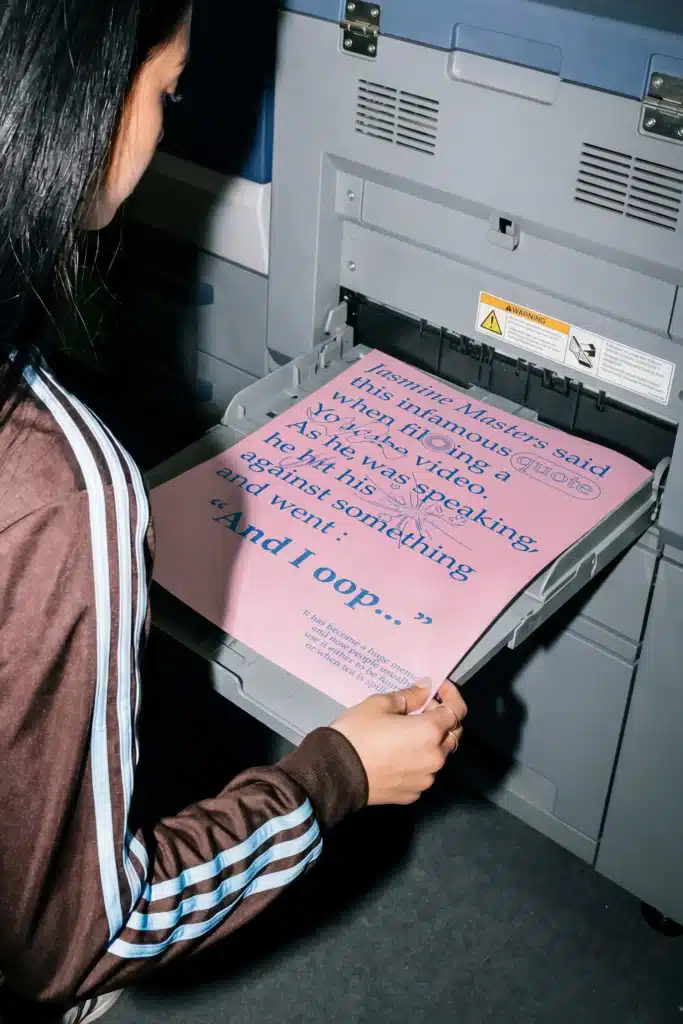
Giclée printing is the standard for fine art reproduction. The name comes from the French word for “to spray” — which is exactly what happens.
How giclée printing works
Ink is projected onto the paper in microscopic droplets, at a resolution high enough that the result is indistinguishable from a continuous tone image. A giclée print is essentially a high-quality fine art print made using professional inkjet technology, but the term refers to more than simply printing with an inkjet printer.
What makes giclée different is the combination of professional printing technology, pigment-based inks and high-quality fine art paper. Pigment inks are more stable than dye-based inks and are designed to resist fading over time. Paired with archival paper, a properly produced giclée print can remain stable for many decades, depending on how it is displayed and stored.
Giclée vs. regular inkjet printing
Every giclée print comes from an inkjet printer, but not every inkjet print is a giclée. A standard home or office printer is designed for everyday documents and uses a limited number of inks, often dye-based. Those prints are not made with long-term stability in mind.
Giclée printing uses professional printers with a wider range of pigment inks, allowing for more precise colour reproduction, subtle tonal variations and fine detail. The difference isn’t necessarily obvious on day one. It becomes more important over time — particularly when a print is exposed to light, humidity or other conditions that can accelerate fading.
The paper matters as much as the ink
Giclée prints are typically made on high-quality fine art papers, including cotton rag and other archival papers. The choice of paper affects more than durability. It changes the texture, depth and way colours appear in the finished print.
A print on cotton rag has a different surface and feel from one on a smoother coated fine art paper. Neither is inherently better, but each gives the artwork a different character.
This is why the paper is part of the printing process rather than simply something the image is printed onto.
Why giclée prints are archival
A giclée print can be archival when the entire printing process is designed for longevity — from the pigment inks to the paper and the way the finished print is handled.
Archival quality doesn’t come from the word “giclée” alone. It depends on using stable pigment inks, high-quality acid-free or archival papers, and appropriate storage and display conditions.
A properly produced and cared-for giclée print can remain stable for many decades. Direct sunlight, humidity and poor storage can shorten that lifespan, so how a print is displayed matters too.
Why it matters when you’re buying an art print
When you’re choosing between two similar-looking prints online, giclée is usually what separates the one you’ll still love on your wall in ten years from the one that’s shifted or faded by then.
It’s also why a giclée print costs more than a poster from a big-box store — you’re paying for pigment ink, fine art paper and a printing process designed to reproduce the artwork accurately and last.
If you’re framing something, hanging it somewhere with natural light, or buying it as a gift meant to last, it’s worth checking how it has been produced. Every print in this shop is produced this way by default, so it’s one less thing to think about.
Colour accuracy
Colour accuracy is another reason giclée has become the standard for art prints. The process allows for a wide colour gamut and a high degree of control over how colours and tonal variations are reproduced.
Subtle shades, gradients and details that can be lost or flattened in standard printing can be retained much more faithfully. For artwork where colour is part of the original character, that accuracy matters.
Why it works for limited editions
It’s a slower, more expensive process than mass printing. Which is part of why it works for limited editions — you’re not printing ten thousand copies, you’re printing a hundred, carefully, on materials that are meant to last.
Giclée printing also makes sense when consistency matters. Each print can be produced to the same high standard, with the same paper, inks and colour settings, rather than being treated like a mass-produced poster.
At Studio Ninette, our prints are produced using giclée. It’s the process that does the most justice to the work — the colours, the detail, the way the image sits on the paper.
— Studio Ninette, designed in Belgium.